OSU Navigation Bar

The Ohio State University

Office of Distance Education and eLearning

Digital Union

Home > Blog > Touring the Duderstadt at University of Michigan

Touring the Duderstadt at University of Michigan

Dave Hooker
"Image of computers for scanning, video editing, and media conversion at U of M Duderstadt"

Video editing, scanning, and media conversion

The Duderstadt Center at University of Michigan

Two weeks ago, I was invited on a tour at The University of Michigan’s Duderstadt Center, along with 10 colleagues from Ohio State University.  The trip was sponsored by Interim Dean Mark Shanda from The College of Arts and Sciences.   As the manager of The Digital Union, I was interested in what was happening at other CIC schools across the Midwest. If U of M is any indication, Ohio State University may be falling behind in the purchase and use of new technologies on our campus. In the interest of comparison, it seemed wise to look at what was available at The Duderstadt, and compare those resources to those available at OSU.

3D Printing:

"photo of two 3D printers in the imaging lab, U of M Duderstadt"

3D printers in the 3D lab

3D printing is basically an inkjet printer which substitutes plastic or plaster for the ink. As the print arm adds layers of the printed material, the backing table drops lower with each pass, thereby layering up material on the third dimension as defined by the item’s design in a CAD program. The Duderstadt had two of these printers for rapid prototyping of parts and models in their space. OSU has two labs for 3D printing as well, located in either the Digital Fabrication lab of The Knowlton School of Architecture for architecture students, or within the Dimensional Imaging Research Lab at Haskett Hall, which is open to art students who take Art 452.

'Person looking at a 3D representation of an interior space

Looking at an interior space from a 3D perspective

3D imaging, or ‘the cave’

The University of Michigan is the second CIC institution I’ve visited with a space devoted to 3D viewing; generally referred to a ‘cave’. If you enter the space with 3D glasses, your view is tracked and the images on the walls shift to match the perspective of your view in real time. I first encountered this technology at Purdue two years ago, in addition to seeing it again last week. To my knowledge, OSU has no such spaces on campus. The ability of a designer, architect, or engineer to ‘see’ their creation in three dimensions before committing to the design will probably become an industry norm in the future.


'Image of a 3x3 monitor array for display of high quality, high magnification images'

3x3 monitor wall for display of high quality images at high resolution

High Definition Video Wall

The Duderstadt was equipped with a multi-video card computer set up to drive a bank of 9 high definition monitors set up in a grid. The system is most used by students who are looking at circuit design. To my knowledge, this sort of facility is not available at OSU.


'Image of the console for one of the recording studios at U of M'

Recording studio console, with room for talent behind

Audio recording Studios
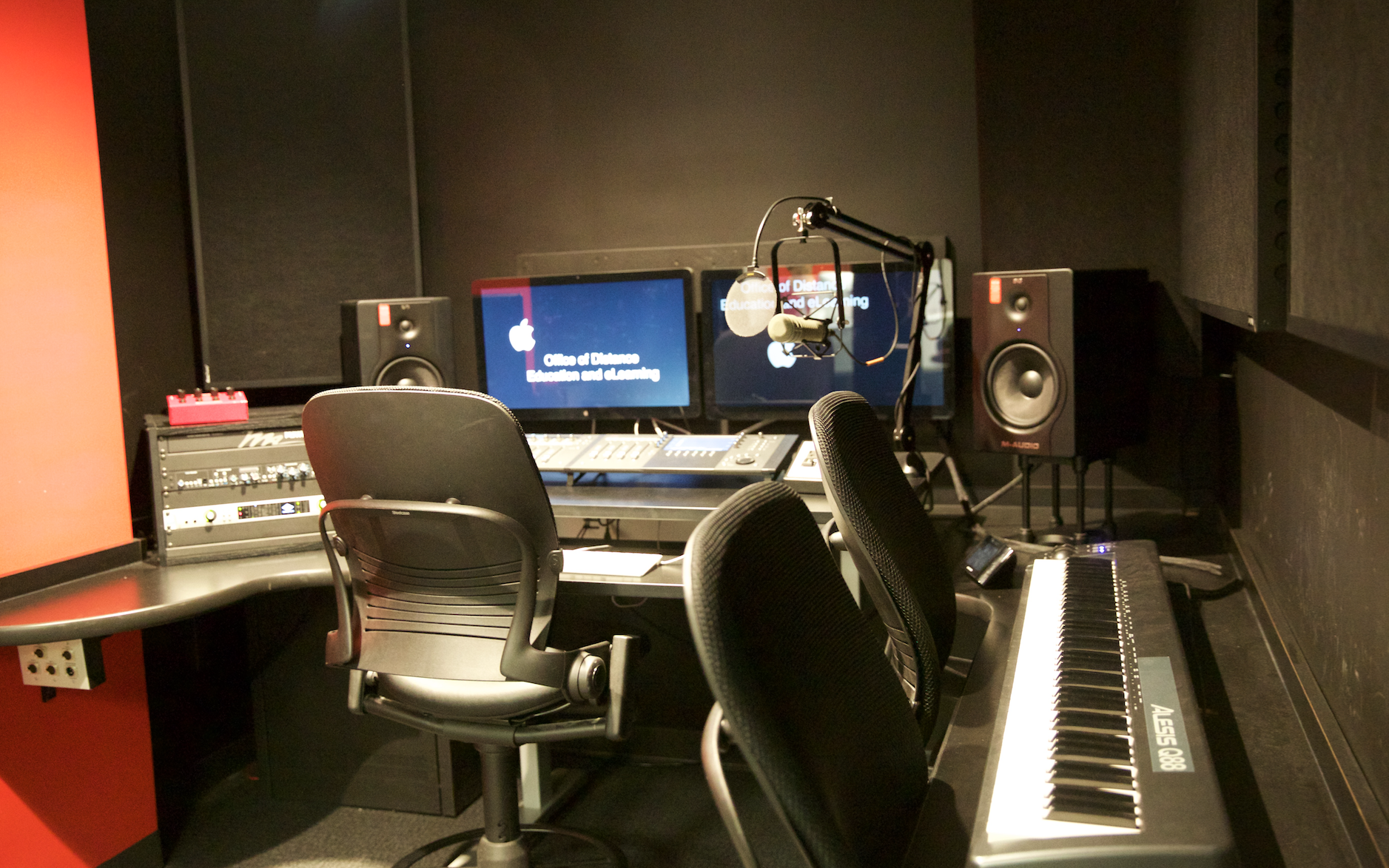
The Duderstadt housed 3 electronic music recording spaces for sound engineering, as well as a fourth recording studio with space for 20 musicians. The space is used for music majors to perfect and record compositions; additionally the spaces are outfitted for 5.1 and 7.1 Surround Sound, which are commonly used conventions in modern home theaters.  The University of Michigan also has 3 or 4 lecture-capture rooms with video, teleprompter, and lighting in front of a podium, as well as several small podcast booths.

On the OSU campus, we have various small recording studios scattered across the campus including spaces in the Digital Union and Denny Hall, Howlett Hall, Ramseyer Hall, The Fisher College of Business, and Hagerty Hall. Many of these facilities are only open to students within a specific college; only the Digital Union and Ramseyer hall facilities are open to all students, faculty, and staff.

'Image of the lighting grid above the video studio at Duderstadt center'

The lighting grid above the video production studio

Video Studio

The Duderstadt video studio is a large space, outfitted with a forty foot section of green screen and lighting rigs on motors that can be lowered to the floor to modify the lighting easily. The space has a boom camera and facilities for multi camera shoots. Because demand is so great for this space, projects are ranked against criteria of how interesting the project might be, whether it can create collaborations between students of different colleges, and if the entire video can be created, from scenery build to tear down, in one week, which is the limit for any project in this studio.

On the campus of OSU, there are several small video recording spaces such as a small green screen space in Ramseyer Hall, a soon to be completed small space in Denny Hall, and small video space in Howlett Hall.  The Howlett Hall location is limited to College of Arts and Sciences faculty and staff. At a higher level, there is a studio in the basement of Bricker Hall, the Atwell Hall College of Medicine recording studio that will close soon, and the studios of WOSU, which are available on a fee basis.

'image of podium with teleprompter and lighting for lecture capture'

Lecture capture room for faculty

As I searched for these resources on the OSU website and through contacts across the university, the problem of wide spread resources that are hard to find and restricted by college became painfully obvious. I am certain there are recording and video studios squirreled away around campus which I have missed, my inability to quickly identify these resources and determine who can use them only highlights the issue. If all this equipment and budget were gathered together, we could have a great facility here at OSU that was available to all. Isn’t it time to bring the ideals of ‘One University’ home?

VN:F [1.9.22_1171]
Rating: +18 (from 18 votes)
RedditPinterestLinkedInShare
This entry was posted in Digital Media, Learning Spaces, Technology (General) and tagged , , , , , . Bookmark the permalink. Both comments and trackbacks are currently closed.

One Comment

  1. Posted August 2, 2011 at 7:13 pm | Permalink

    Another form of 3D printing uses subtractive technology, rather than the additive method mentioned above. To see an example of this type of technology, take a look at 2BOT’s ModelMaker.